Showing posts with label Archaeology. Show all posts

Friday, April 5, 2019

Peñas Altas: a forgotten colonial military fortification

Welcome back blog readers. New publication available!
It is with great pleasure once more that I announce the publication of yet another of our papers in the series dedicated to the archaeology and history of the military fortifications of the bay of Matanzas, Cuba. In this occasion, we discuss new evidence – of archaeological, historical and geological nature –pertaining to the battery of Cagigal or Peñas Altas. Demolished in 1962, this battery was converted to a park and nearly forgotten by locals, was named in the honor of one of Cuba’s colonial governors: don Juan Manuel de Cagigal y Martinez, who governed the island from 1819 until 1821.


One of our new discovered fort plans made it to the cover:
Penas Altas battery plan of 1819


 An abstract of the paper reads thus:

The coastal battery of Peñas Altas was the last fortification to complete the defensive system surrounding Matanzas Bay, Cuba. This research offers new information gathered from the analysis of unpublished maps, historical archives, and a preliminary archaeological survey. Such information has allowed us to limit the construction of the fortification between December 1819 and 1820, and not in 1818- 1819 as assumed by traditional historiography. Four important moments in its evolution are identified: planning and construction (1818-1827), remodeling (1840-1850), expansion (1876-1886), and a second remodeling in 1907. Peñas Altas functioned as a military post throughout the nineteenth century, and later became a police station and munition warehouse until its demolition in 1962. Only a few walls and part of the platform remain, however, they represent an important part of the lost heritage with potential for further research and tourism development.

The paper presents several unknown or inedited documents, plans, maps and photographs that record the history of the battery and the changes it underwent through Cuban history. We also explore the preservation of several of its surviving features and the possibility of turning its current state into a historical park.

The article is available on my other pages here, or on the page of the scientific journal Arquitectura and Urbanismo, on which it was published.

Thank you once more for reading and visiting. Stay tuned for more news!


Recommended citation

Hernández de Lara, O., J. Orihuela León & B. Rodríguez Tápanes (2019). Batería de Peñas Altas: apuntes histórico-arqueológicos sobre una fortaleza olvidada (Matanzas, Cuba). Revista científica de Arquitectura y Urbanismo, XV, 1: 5-22.

Friday, January 25, 2019

New Book: Cuba, Archaeology and Historical Legacy

A new book on Cuban archaeology was presented this past January 25, in the old city of La Habana, Cuba. The event was sponsored by the city of Havana historian's office, the Montane Anthropological Museum and the Cultural Patrimony Council. The title of the work is "Cuba: Arqueología y Legacía Histórica" (Polymita).


This is an important contribution, which in the constellation of other recent works - which includes several important articles and full-length treaties on several themes – gathers some of the most significant minds of Cuban archaeology of the XX and XXI centuries.


The book includes a series of diverse articles touching upon current issues and problematica in the fields of archaeological and historical research in Cuba. There are sections on the interpretation of aboriginal or prehistoric burial practices, use of fauna, and applications of theoretical archaeology; plus, the interpretation of the chronicles penned by conquistadores during the first decades of the colonization. Moreover, it includes an array of classic works on physical anthropology, toolkits and technological usage of wood and mollusks. The contributions provided both by the young and the older, though distinguished, generations of archaeologists. Among them, some of the most renown names in Cuban and Caribbean archaeology.


Within the attendees were the city historians Eusebio Leal Spengler (La Habana) and Ercilio Vento Canosa (Matanzas), the conservator of the city of Matanzas, Leonel Perez Orozco, among other prominent Cuban archaeologists. Presenting were Jorge Garcell of the council of Cultural Patrimony and the photographer - wind beneath the wings of this publication- Julio Larramendi.

Please, join us in congratulating our friends and colleagues, those that made within and outside the covers, for this important contribution.


A complete list of the book’s content is here provided (in Spanish):

PRÓLOGO
José Barreiro

LOS ESTUDIOS SOBRE ARQUEOLOGÍA ABORIGEN EN CUBA: TEORÍAS Y APRECIACIONES
Armando Rangel Rivero
LAS COMUNIDADES ABORÍGENES DE CUBA. CENSO 2013
José Jiménez Santander, Liamne Torres La Paz, Dany Morales Valdés y Lisandra Jiménez Ortega

CRÓNICAS Y CRONISTAS DE INDIAS OCCIDENTALES
Ulises M. González Herrera

VIDA COTIDIANA Y ORGANIZACIÓN SOCIAL DE LAS COMUNIDADES ABORÍGENES DE CUBA
Lillián J. Moreira de Lima

POBLACIÓN ABORIGEN PRECOLOMBINA. DESCRIPCIÓN DE LAS CARACTERÍSTICAS CRANEALES Y LA ESTATURA
Manuel F. Rivero de la Calle

LA ALIMENTACIÓN DE LOS ABORÍGENES DE CUBA
Roberto Rodríguez Suárez y Yadira Chinique de Armas

EL ARTE COMO EXPRESIÓN SOCIAL DE LOS ABORÍGENES DE CUBA
Lourdes Sarah Domínguez González

ANIMALES EN EL ARTE ABORIGEN
Carlos Arredondo Antúnez y Rafael Borroto-Páez
PINTURAS Y GRABADOS RUPESTRES EN EL ARCHIPIÉLAGO CUBANO
Divaldo A. Gutiérrez Calvache y José B. González Tendero

MEDICINA DE LOS ABORÍGENES DE CUBA
Enrique Beldarraín Chaple

LOS BATEYES ABORÍGENES: JUEGO Y RITO EN EL ESPACIO COMUNAL
Daniel Torres Etayo

COSTUMBRES FUNERARIAS: LA MUERTE, EL ESPACIO Y EL TRATAMIENTO DEL CADÁVER EN LAS COMUNIDADES ORIGINARIAS DE CUBA
Jorge Fernando Garcell Domínguez

LOS ABORÍGENES Y EL USO DE LOS MOLUSCOS
Alina Lomba Garmendia y Daniel Torres Etayo

LAS INDUSTRIAS LÍTICAS DE LAS SOCIEDADES ABORÍGENES EN CUBA
Gerardo Izquierdo Díaz

LAS MADERAS EN LOS OBJETOS ABORÍGENES CUBANOS
Raquel Carreras Rivery
LA INDUSTRIA DE LA MADERA DE LOS ABORÍGENES DE CUBA
Gabino La Rosa Corzo

EL ÁREA ARQUEOLÓGICA LOS BUCHILLONES: ZONA EXCEPCIONAL PARA EL CARIBE
Adrián García Lebroc y Jorge Calvera Rosés

EL CHORRO DE MAÍTA
Roberto Valcárcel Rojas

EL LEGADO ARUACO EN EL ESPAÑOL CUBANO
Sergio Valdés Bernal

DESCENDIENTES DE LOS ABORÍGENES CUBANOS
Manuel F. Rivero de la Calle

LA HUELLA ABORIGEN EN EL PATRIMONIO GENÉTICO DE LA NACIÓN CUBANA
Beatriz Marcheco Teruel

ENTREVISTA A ALEJANDRO HARTMAN, HISTORIADOR DE BARACOA Y DIRECTOR DEL MUSEO MATACHÍN


Photographs published here are courtesy of personnel of the Oficina del Historiador de La Habana. Most special thanks to Lisette Roura Alvarez (C).

Tuesday, January 2, 2018

Few research abstracts: 2015 - 2017

As the first blog post of the new year, this fulfills one of the goals of this page: to put new research discoveries, curiosities and research findings in the view of the general public. I will be sharing a few of my most recent research findings through the abstracts of their journal publications.

Thus, without much ado, here they are:


Spanish (Catalonian) clay tobacco pipes from Castillo de San Severino; early-mid XIX century

The clay tobacco pipes of Castillo de San Severino fort (Matanzas, Cuba): typology, spectroscopy (SEM-EDS) and contextual analyses

Here we provided a detailed study of a clay tobacco pipe collection, based on typology and using energy dispersion spectroscopy (SEM-EDS), recovered from fort Castillo de San Severino, Matanzas, Cuba. The pipes came from a trash deposit that dates to between the late XVIII century and the late XIX century. The collection includes pipes of north European traditional typology, such as Dutch and English, plus reed-stemmed pipes, including pipes from Catalonia (Spain) and eastern Mediterranean
such as the Balkans. The EDS analysis suggested that the samples studied are not likely of local manufacture, or manufactured with local clays. Our study, based on historic documents and artifact analysis, contributes to the general history of the fort by providing an interpretation of the socioeconomic factors controlling the culture of pipe smocking at the fort. Our data adds valuable information on the archaeology of these portable artifacts in the fort and the region.


New Stereoviews of San Jose de la Vigia, Matanzas, Cuba: A historical contribution and new archaeological perspectives

Here we reported five stereoviews that reveal details of Matanzas city during the mid-XIX, particularly of the Plaza de la Vigía and the fort of San José de la Vigía, previously unexplored in the local historiography. These rare photographs are an invaluable resource to the historic, preservation and archaeological research of these features, which such as the fort, are today long gone. In comparison to the known etchings and sketches, these photographs constitute a less distorted record of the city.


Cover of Cuba Arqueologica, prestigious journal of Caribbean archaeology, with a
stereoview photograph of Plaza and fort La Vigia, Matanzas, Cuba, in 1859.


First report of the marine mollusk Busycon perversum (Gastropoda: Busyconidae) from the archaeological site of El Morrillo, Matanzas, Cuba

Here we reported the presence of the mollusk Busycon perversum in the archaeological site of El Morrillo. Although several species of Busycon are known from colonial sites in Havana, this constitutes the first confirmed record of this alocthonous species in region of Matanzas. This finding, as in the cases in Havana, are interpreted as importation or exchange between Floridian Amerindians, such as the Calusa or Tekestas, in Cuba during the early centuries of the island's colonization. However, it could have been introduced in Cuba also by sailors visiting the Gulf of Mexico and Florida.

Busycon perversum juv. from El Morrillo

The First Battle of the Spanish-Cuban-American War (1898): Insights from a Historical and Archaeological Perspective

The Spanish-Cuban-American War of 1898 constituted not only the events leading to the start of the first modern war but also marked the beginning of the colonialist expansion of the United States throughout the world. The explosion of the USS Maine in Havana’s harbor has often been interpreted as the excuse used by the US to get involved in the Cuban War of Independence; a war that Cubans and Spaniards had been fighting since 1895, but rooted since 1868. Previous research has traditionally focused in the naval encounters of the Spanish and US fleets in Santiago de Cuba, or the end of the war with the occupation of Puerto Rico, the Philippines, and Guam, thus underestimating the role of the Cuban troops and leaving the early events of the war poorly explored. Our research focuses on the first battle of the war, which occurred on Matanzas Bay, Cuba, on April 27th, 1898. Historic documentation from Cuban, Spanish, and US archives is analyzed, and compared to the available archaeological data, to deepen the understanding of the defensive and offensive strategies employed, and their impact on the media and their publicist strategies.

Image, mounted on glass of the bombardment of Matanzas by three USS warships in 1898


Contribution to the chronology and paleodiet of an aboriginal individual excavated in the archaeological site of El Morrillo, Matanzas, Cuba

El Morrillo, an archaeological site localized on the margin of the Canímar River, in the bay of Matanzas, is considered one of the most important agroceramist culture deposits of western Cuba. Despite its importance and richness, only one radiocarbon date, based on charcoal, had been reported from this site since 1966. Here we provide the first AMS 14 C date measured directly from human remains, excavated in 2009, along with a carbon and nitrogen stable isotope analysis to infer the diet of this individual. The AMS 14 C provided a radiocarbon age of 420±40 rcyBP (AP) (2σ calAD1420-1523). These results indicate a post-Columbian time of burial, likely near or during the first decades of the Cuban conquest early in the XVI century. The stable isotopes suggest that the individual had a mixed diet, with intermediate carbon consumption, and high on marine/riverine resources, which suggest the exploitation of the nearby coastal and fluvial ecosystems. These values are generally comparable to several populations of similar filiation in the Greater Antilles. Our results highlight the importance of El Morrillo in the study of agroceramist communities in Cuba and the Caribbean.

Cover of Cuba Arqueologica with an architectural plan of La Laja,
interesting water locked fortification planed for the center of the bay of Matanzas
that was never completed.

Plans for a fort in the middle of the bay of Matanzas: La Laja

The construction of fortifications in strategic or advantageous localities constituted a main method of military landscape colonization. With the economic boom of Matanzas's city, in northwestern Cuba, the importance of the growing port incited the planning of several strategic defense points, but many of them were not completed. One of them, named La Laja, planned in the center of the bay was one of such strategic localities selected for a fortification and lighthouse. Here we analyzed and reported eight unpublished plans that document several of the different projects planned for La Laja. These plans provide insight into the constructive dynamics and the evolution of defense fortifications surrounding the port and city, in this case where the bureaucracy and demolition of fort La Vigia prevented the completion of what could have been a singular and unique engineering feature.

To our great joy, several of our paper's illustrations made the journals front image. None of these accomplishment would have been possible without the help and encouragement of my coauthors, Ricardo Viera Munoz, Odlanyer Hernandez de Lara, Leonel Perez Orozco, and Osvaldo Jimenez. Moreover the patronage and encouragement of Adrian Tejedor, Herman Benitez, and many others that with their guidance and help, made our research process fun and educational. Our most sincere thanks.

For more information visit our other blogs and pages:

San Carlos de Matanzas

Progressus: Arqueologia, Patrimonio y Desarrollo Social

Research Gate

Visit us and stay tuned!

Friday, September 15, 2017

The mandible from Puerto Principe: The search for human antiquity in Cuba

In 1847, Miguel Rodriguez Ferrer discovered partially fossilized human remains near Los Caneyes, on the southern coast of Puerto Principe, modern Camagüey province. A human mandible among them would figure as one of the inciting pieces that lead the search for mankind’s antiquity in Cuba.


Miguel Rodriguez Ferrer was a Spanish geographer and naturalist, an erudite who visited Cuba on several occasions during the XIX century. He is the author of Naturaleza y Civilización de la Grandiosa Isla de Cuba (1876-1878), an extensive two-volume book on Cuba’s history and natural science – among the first to scientifically divulge the island’s natural history.


Ferrer’s archaeological discoveries were by no means the first. In fact, his expedition to Los Caneyes was sparked by a letter sent to him with news of previous descoveries. On June 23, 1847, Pedro Santacilia informed him of known “fossilized” human remains – a cemetery – discovered in 1843 by Bernabé Mola in a coastal site or cay called Estero de Los Caneyes, near the bay of Santa Maria Casimba, south of Puerto Principe. 

Sr. Mola, also a Spaniard, had published the news of his discovery under the title “Fossil Human Skeletons” on the Memorias de la Sociedad Económica de La Habana (Memoirs of the Economic Society of Havana, 17: 457). By then Ferrer was well acquainted with most of the Cuban eminent scientists, such as Felipe Poey Aloy, his son Andres Poey Aguirre and Antonio Bachiller y Morales; the last two considered today the fathers of Caribbean archaeology. 

A “fossilized” mandible figured among the remains Rodriguez Ferrer found at Los Caneyes. Immediately, the context of this discovery  an indurated or mineralized layer of ash, shell fragments, and gravel – suggested great antiquity for the specimen, and implied the presence of several cultures of different levels of technological advance in the area. Ferrer referred his specimens to Felipe Poey, who studied them in detail. Poey published part of his results in his Repertorio Físico Natural de la Isla de Cuba (1866) but did not mention the curious mandible. 


The mandible, among other artifacts, had been donated to Spain in 1850 and forgotten for 14 years. It was not until 1871 that the mandible and the other human remains were studied again. Ferrer the gave the specimens to academics of the Spanish National Museum, among them Sr. Graells, who estimated that they were fully fossilized and likely older than the European Stone Age, meaning greater than 30,000 years in age; thus creating sort of a Stone Age period for Cuba by transposing aspects of European archaeology and natural philosophy to our insular contexts based on their stratigraphic association.

The remains excavated by Rodriguez Ferrer were then studied by Henry de Saussone, who showed in the Madrid Americanist Congress of 1881 that the specimens, especially the mandible from Puerto Principe, were not fully but partially mineralized, and could instead be just several thousands of years old. Therefore, pre-Columbian in age and not from the Stone Age.


By then, one of Cuba's foremost scientist and among its first anthropologists, Luis Montané had discovered human remains in better-preserved contexts, such as those of Cueva del Purial, in the mountains of Banao in the province of Santi Spíritus. Several of Montané’s specimens were studied by the prominent Argentinian paleontologist Florentino Ameghino, who classified them as Homo cubensis, in part following the tradition of Homo diluvii testis of Cuvier, postulated nearly a century before.

Montané, however, did not agree with Ameghino’s classification and did not consider the Cuban human remains, nor the mandible from Puerto Principe, as a new fossil species, but instead as regular modern human – Homo sapiens, and indeed the mortal remains of one of Cuba’s native pre-Columbian population. 

It is thus how the mandible from Puerto Principe discovered by Rodriguez Ferrer became a symbol of the search for Cuba’s earliest native populations. Those remains were the first to stimulate questions regarding the diversity of Cuba’s native cultures, their chronology and the relationship of their contexts. The discovery of the Amerindian mandible from Puerto Principe in 1847 consequently marks the serious beginning of pre-Columbian archaeology and anthropological research in Cuba and the search for mankind’s antiquity in the Caribbean islands.


Tuesday, August 22, 2017

La Flauta de Arroyo del Palo

Por Osvaldo Jiménez Vázquez
Gabinete de Arqueología, Oficina del Historiador de La Habana, Cuba

Osvaldo Jimenez Vazquez
La Flauta de Arroyo del Palo

El joven flautista había muerto. Junto a su cadáver depositaron, entre lágrimas, su preciado instrumento, una pequeña flauta de hueso. Previamente quebraron el aerófono, para que nadie volviera a tocar aquel bien tan valioso al ejecutante, para que su espíritu, y el de la flauta, coexistieran en paz más allá de la vida terrena. Allí, al abrigo de la solapa descansaría eternamente la fracción material de los compañeros, y en la dimensión espiritual, sus almas continuarían la amistosa relación.

En vida, la flauta había sido una amiga inseparable, compartiendo ceremonias, penas y soledades. Los limitados sonidos de aquel instrumento le llevaban en espíritu a lugares insospechados.

La historia común había comenzado a las orillas de una laguna costera, donde el adolescente cazaba junto a los hombres de la tribu. Esta laguna estaba situada al borde de la actual bahía de Nipe, unos 12 km al noroeste de su aldea. Allí se encontró con el cuerpo exánime de aquella gran ave, el pelícano, al cual pidió con respeto el hueso de una de sus alas. Lo preparó cuidadosamente, con cortes en ambos extremos, la perforación de dos orificios para los dedos y el pulido final. Ya lista, la colocó suavemente entre sus labios y sopló, a la vez que modulaba con los dedos la salida del aire. Entonces, la tenue voz del espíritu que habitaba en ella se expresó a través del sonido musical, fusionándose soplo y sonido en una voz común.

Juntos vivieron muchas aventuras, pues el adolescente nunca se separaba de ella, a veces viajaba colgada a su cuello mediante una cuerda, y otras, descansaba dentro de un bolsillo de piel de jutía. Ella y el eran uno
”.

Esta recreación poética parte de un hecho verídico. En la década de 1960, miembros del grupo de aficionados a la arqueología Mayarí hallaron la flauta junto al cadáver de un adolescente masculino aborigen, en el sitio arqueológico Arroyo del Palo, en el municipio Banes, provincia de Holguín. Este hallazgo se produjo cuando revisaban una oquedad que se abría en la pared del abrigo rocoso, a nivel del suelo. Este descubrimiento fue relevante, ya que los instrumentos musicales son raros en contextos arqueológicos de la Cuba prehispánica. Aerófonos de diversos tipos se han hallado, entre ellos flautas elaboradas de huesos humanos y de roedores. Fabricada a partir de un hueso de ave, solo se conoce el ejemplar de Arroyo del Palo, pieza que se exhibe actualmente en la sala expositiva del Instituto Cubano de Antropología (ICAN), sito en calle Amargura entre Habana y Aguiar, en La Habana Vieja.

El sitio Arroyo del Palo fue habitado por aborígenes recolectores, cazadores y pescadores, artífices de una cerámica de factura simple y que practicaban, además, una agricultura incipiente, incluyendo, quizás, especies de plantas similares a las identificadas en el sitio homologo Canimar Abajo, costa norte de Matanzas. Estas eran, boniato (Ipomoea batatas), yuquilla de ratón (Zamia cf otonis), mate de costa (Canavalia sp.), frijól (Phaseolus sp.), y una planta marantácea indeterminada.

Arroyo del Palo fue habitado, según dos fechados C14, entre los años 1190 y 980 de nuestra era (Tabío y Rey, 1985). Los habitantes de este sitio mantuvieron en algún momento nexos con los aborígenes de la isla de Jamaica, de la cual trajeron un ejemplar de la jutía de Brown (Geocapromys brownii).

Hasta este momento se desconocía la especie que había aportado el hueso para la flauta, por lo cual se realizó un examen de la misma, comparándola con materiales óseos de la colección de referencia del Gabinete de Arqueología (Oficina del Historiador de La Habana) lo cual permitió definir que fue fabricada a partir de la diáfisis de una ulna izquierda de pelicano (Pelecanus spp.). En el hueso se observó la curvatura típica del hueso de esta ave y las cotilas dorsales para la inserción de las plumas secundarias, aún cuando la superficie externa fue rebajada. El rebaje hizo desaparecer, sin embargo, las cotilas ventrales, menos eminentes que las dorsales.

La pieza mide unos 100 mm de largo y 11 mm de diámetro, presentando en la cara posterior dos orificios circulares de 4 mm para los dedos. Alrededor de estos orificios observamos el desgaste producido por los dedos durante la etapa de uso.

Uno de sus extremos esta fracturado, estimándose la longitud original en unos 120 mm. La fractura que presenta esta flauta pudiera ser intencional, con el fin de inutilizar el objeto mágico-religioso cuyo propietario había fallecido. La práctica de inutilizar objetos de los difuntos se conoce en otras culturas aborígenes históricas, por ejemplo, los Calusas del suroeste de la Florida perforaban sus recipientes de concha de Busycon a la muerte del propietario para así matar el espíritu que habitaba en ellos.

Que sepamos, en Las Antillas no se han hallado aerófonos facturados en huesos de aves. Según los arqueólogos Ernesto Tabío y J. M. Guarch, flautas similares se han reportado en sitios aborígenes del sudeste de Virginia, Estados Unidos, asociados a la cultura Woodland, que floreció entre el año 1000 antes de Cristo y el 100 de Cristo. En centro y Sudamérica se conoce del hallazgo de flautas elaboradas a partir de huesos de pelicano (Pelecanus spp.). Estas se encontraron en el sitio Caral, Valle de Supe, en los Andes peruanos, fechado en el tercer milenio antes de Cristo, y en el sitio Sierra (Aguadulce), en Panamá, con cronología entre el año 2 y 222 de Cristo. En este último sitio el hueso utilizado para fabricar la flauta fue un húmero, y, al igual que en Arroyo del Palo, el aerófono estaba asociado a un enterramiento humano. Ninguna de las culturas mencionadas tiene relación con el hombre del sitio Arroyo del Palo, solo hacemos referencia a ellas desde un punto de vista comparativo.

Las flautas acompañaron al hombre antiguo en todo el mundo, las más antiguas proceden del Paleolítico Superior Temprano (Aurignacience) de Francia y Alemania. Aquellas que se sostienen verticalmente, como la de Arroyo del Palo, representan las formas más tempranas. En las culturas más antiguas, estos instrumentos musicales se construían preferentemente de huesos de animales, específicamente de las alas de aves, que resultan muy adecuados para estos fines, porque son ahuecados, delgados y fuertes, lo que posibilitaba perforarlos sin grandes riesgos de fractura. En el Viejo Mundo, comúnmente se usaron para estos fines los huesos de buitres (Gyps fulvusAegypius monachus).


Monday, August 8, 2016

Progressus: A project for Cuban Archaeology


Several months ago I expressed my excitement in becoming part of the archeological project Progressus. Since then, I have collaborated with Odlanyer Hernandez, Boris Rodriguez, Cristian de la Rosa, Leonel P. Orozco, Jorge Garcell, and Ricardo A. Viera (to name a few); all Cuban archeologists and historians at the front of archaeological research, and concerned with the integration of archaeological and historical data in the rescue and preservation of Cuban cultural heritage.

Since then, Ricardo Viera and I have written two small notes on several aspects of Matanzas history and archaeology. One is dedicated to the bombardment of the city of Matanzas 27 April 1898. This was the first bellic act of the Spanish-Cuba-American war soon after the USS Maine blew in the bay of Havana on February 15 of that same year. The other pertains to our research on the archaeology of clay tobacco pipes excavated from fort Castillo de San Severino and published in the International Journal of Historical Archaeology, aforementioned here.

Some of our colleagues and members of Progressus mentioned above contributed greatly to this research since many of them have published extensively on the fort's archaeology. It is my pleasure to be able to contribute to their great body of research and to be part of their team. Moreover, there are plans of making Progressus a great venue for international collaboration, including Argentinean, Swedish, Cuba, and American researchers to deepen our understanding of Cuban historical archaeology.

Please visit Progressus blog here to meet our colleagues, and to stay informed on our work, contributions, and future plans. There you will find articles, photographs, and articles on battlefields, fortifications, and artifacts related to the local history of Matanzas, Cuba. There are surely interesting findings down the pike, as we continue to unravel our common history.

Stay tuned for more news!


Monday, March 14, 2016

A Very Brief History of Zero


This post is in honor of Pi Day and Albert Einstein's birthday, both which we celebrate today. Although Pi is known to more than a million digits past the famous 3.14159, my post will be about zero, likely our most important number. 

The number zero is included in the sets of whole and complex numbers but not in the
set of natural numbers. Zero is a number placed in the neutral space between the positive and negative numbers on the number line, extending to negative and positive infinite, and thus is neither positive nor negative. Zero has no value and is considered null digit. Mathematicians consider zero an even number based on the premises that if even numbers, when divided by 2 leave no remainder, as odd number do, then is clear that zero is even (1). Moreover, others have stated that it is because if an integer “N” is called even if there exists an integer “M” such that N= 2M. From this, they infer that zeros evenness is clear because zero= 2 multiplied by 0. See (1) and (2) below.

The concept of zero was recognized before the existence of the negative integers was ever considered. Babylonian and Indian mathematicians first thought of the zero around the second to the fourth millennium before the birth of Christ (4000-2000 b. C). However, its real development occurred around 36 b. C. in Mesoamerica. Archeologists hypothesize that other Mesoamerican civilizations like the Olmec may have had some knowledge of the zero much before the Mayans because of number-like hieroglyphs found in their stone calendars, and the values they are supposed to represent. Mayans used mathematics for astronomy and counting. They used their calculations to measure time and to track the stars (2). The use of zero was important because the numeric system depended on the position of the symbol for value; each symbol or glyph represented a level. Zero represented the beginning or no value from where all values originated. The values had additive properties. Precise knowledge of the previous value was crucial to get to the next (4). 


The number zero does not equal emptiness or nothingness. It is the midpoint of our number line and is commonly used to indicate magnitudes or sizes. Think of how we use zeroes every day, in our money, measurements, etc. In fact, the text you are reading now is based on a binary code of ones and zeroes. Mathematics surround us with the number zero playing a central role. 

Cited bibliography


(1)Penner, Robert C. (1999). Discrete Mathematics: Proof Techniques and Mathematical Structures. World Scientific: pg. 34.

(2) “Numeración Maya” retrieved on 2/13/09 from http://es.wikipedia.org/wiki/numeraci%C3%B3n Maya.

(3) Barrow, John D. (2001). The Book of Nothing. Vintage.

(4) Dichl, Richard A. (2004). The Olmecs: America’s First Civilization. Thames & Hudson.

Sunday, February 21, 2016

Project Progressus: Archaeology of Conflict


As you can tell from my posts, I love history, either in the rocks, fossils, or human records. I have recently joined Project Progressus an international research group interested in the archaeology of belic conflicts and the material and collective memories that these events have left behind in Cuba and Latin America.

Project Progressus has a self-titled blog page of which Odlanyer Hernández de Lara, a Cuban archaeologist with extensive work experience in Cuba and Argentina, is the editor and main contributor of blog Progressus. Odlanyer is also the editor in chief of Cuba Arqueológica, a journal that specializes in Caribbean archaeology, but particularly in the communication of advances in archaeological research in Cuba.

The explosion of the USS Maine in the bay of Havana on February 15, 1898, as depicted by an unknown artist for the Muller Luchsinger & Co New York. This incident launched the Spanish-American War or the "splendid little war" as was dubbed by Secretary of State John Hay. 

The scope of the project is to promote and communicate advances concerning the recovery of the material remains and collective memories of battle-conflict archaeology in Cuba and Latin America. This includes not only elucidating aspects of relatively modern conflicts such as the Spanish-American war and the Cuban Missile Crisis but also of conflicts earlier in the colonial period. My colleagues and I will be contributing by participating in field work, workshops, organization, and writing additional posts to increase accessibility to the archaeological information that the project will generate.

I am excited to enter Progressus not only because I will be contributing to the body of historical knowledge and deepen my own about colonial Cuba, but also because I will get the opportunity to collaborate and learn from great archaeologists with a deep understanding of this subject.

Without much ado, the reader is thus redirected to Progressus page for further information and interesting future posts.


Monday, August 10, 2015

Cave Fossil Faunas: Cuba 2015


Once again I am back from exciting fieldwork on the main island of Cuba, the largest of all Caribbean islands. Cuba is an island full of paleobiological treasures and riddles that await to be unraveled. Every year I think of ideas and excuses to return and see things I did not see before.

The Cuban archipelago is comprised of the main island of Cuba, the much smaller Isle of Pines, plus several thousand cays and keys. As you may have noticed from my previous posts, I am biased towards Cuba and the Greater Antilles. This is not only because it is my home country, but because its complex geological history provides a unique opportunity to study the intricacies of the Caribbean's ancient environments and the evolution of its unique biota.


Fig. 1: Pliocene limestone of the Canimar formation on the west banks of the Canimar river, in Matanzas.

This time, I visited with the goal to explore and assess several regions, those rich in caves and fossil remains that were pending from the previous year's roster.

My research involves studying the faunas of the past. In this case, the past faunas of Cuba and the Greater Antilles, which in a way make up an archipelago of their own comprised of the large islands of the Bahamas, Jamaica, Hispaniola, Cuba, Puerto Rico, and their many thousands of keys. With the data, we gather I hope to elucidate the processes of the most recent extinctions there, and the role that humans have played in it, especially the last 5000 years since the arrival of the first Amerindians to the island and later the Europeans. With this, I strive to understand the mechanism and the overall magnitude of their ecological impact. This is, within the scheme of time, mostly after the onset of the last interglaciation, a warm period called the Holocene.

With this in mind, our trip began in the city of Matanzas, on the banks of the Canimar river (fig. 1).


Fig. 2: Cliff cave on the Canimar river gorge, formed on Pliocene limestones of the Canimar fm.

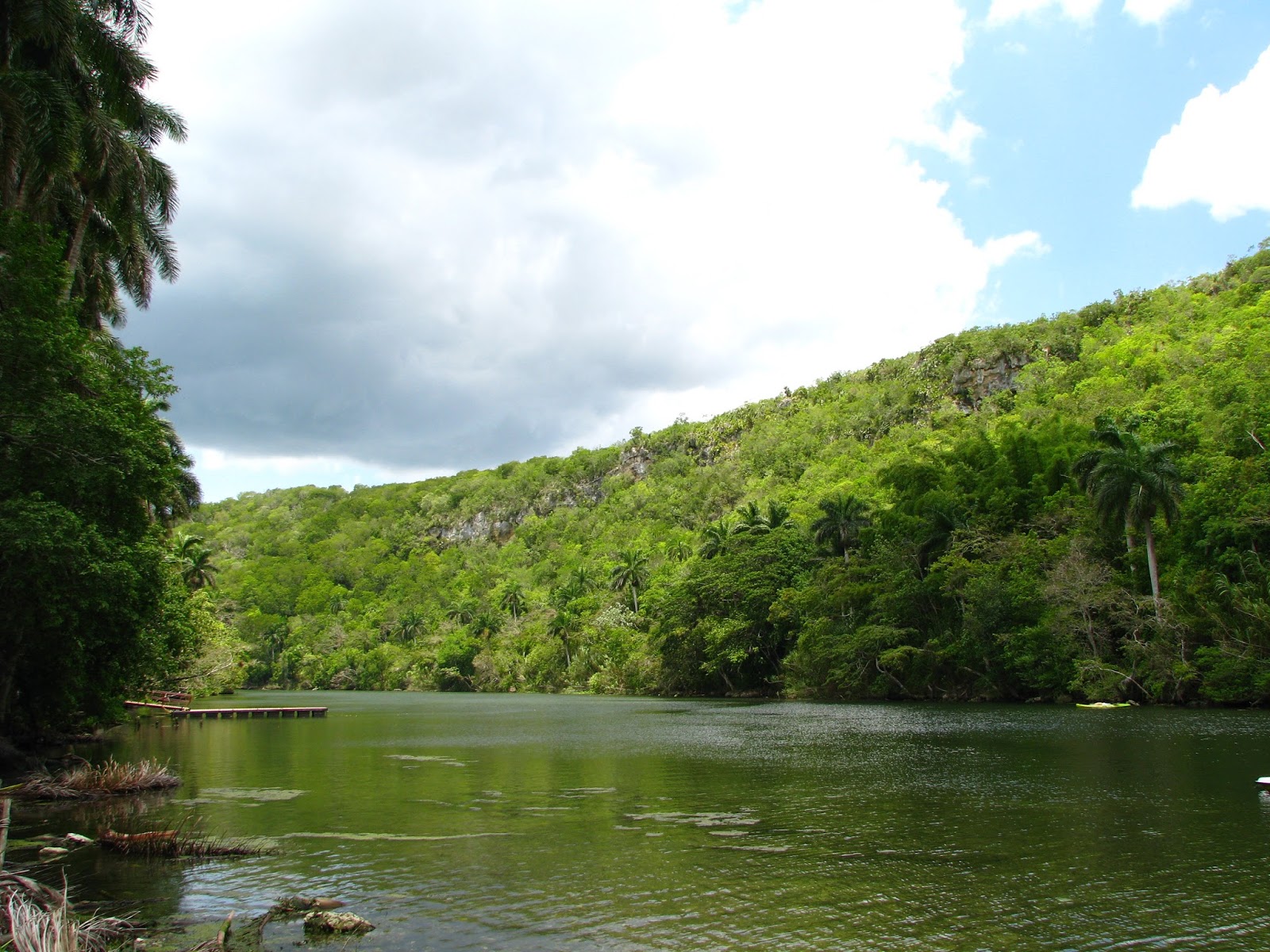
This is a region with deep canyon walls dotted with caves (fig. 2). The caves open up in the limestone of the Canimar formation, rocks that formed between 5 and 2 million years ago in the marine environments that surrounded this region. Then, all this was underwater. Recent tectonic oscillations have risen those lithified marine sediments which the river has carved into a gorgeous, biologically rich gorge; an environment that the Amerindians (native aboriginals) knew how to exploit well.


Fig. 3: The red-legged thrush Tordus plumbeus in the woodlands of the Canimar river. A common member of the local fauna.

The fossil remains of the terrestrial fauna found in the region's cave deposits are very similar to the modern fauna. This fauna is comprised of large rodents called Jutias or Hutias (Capromys spp.), reptiles, amphibians, and a diverse avifauna that includes the red-legged thrush (Tordus plumbeus), like that of figure 3, and the endemic Cuban trogon (Priotelus temnurus) of figure 4.


Fig. 4: The Cuban trogon Priotelus temnurus is a Cuban endemic, and the national bird.

We were targeting caves with large openings or sinkholes (also called dolines) which allow in light, rain, soil, and animals that come to roost within. Other animals wander inside or become trapped, leaving behind the remains of their adventure scattered on the cave floor. As my previous post on Cuban and Hispaniola exploration show (here), these caves are especially important to my research because they have served as a natural reservoir for faunal remains, representative of those that inhabited the region during the last hundred thousand years.


Fig. 5. Large sinkhole complex of Nesofontes' Cave, on Palenque Hill. Here animal
remains accumulated along with other debris that comes in from the outside.

There are few mechanisms that explain the presence of fossil remains within caves. Some fossils are part of the structural rock that makes up the caves. Those fossils are often visible on the cave walls and ceilings. They were part of the marine fauna of the shallow marine environments which gave origin to the limestone that now make up the hills and thus the caves (this process is called karstification if that rock is made out of carbonates like Calcium carbonate). Other fossils are mixed with the soil, plant material, and rock debris that has been dragged into the cave by rain waters or floods over time (fig. 5). Other animals become trapped inside the cave, because they fall in, or are brought in by predators. These are both active and passive mechanisms, both giving way to the accumulation of animal remains within these cavities, and so the treasures of our expeditions.


Fig. 6: Peculiar speleothems within the same cave. This structure testifies to the slow action of carbonatation. 

Caves have interesting water-locked histories. Water that filters through the rocks, laden and heavy with dissolved minerals in their solution, expand cracks within the rocks that eventually, in thousands of years, become caves (like those of fig. 5 and 7). Once these cavities are large enough they start to develop internal microclimates that give way to other secondary formations such as stalactites and stalagmites, collectively called speleothems (fig. 6-8).


Fig. 7: Large lake and sinkhole cave in northeastern Matanzas city: Saturn's Cave. 


Sometimes, parts of the cave's roof or side walls become weak or dissolved by water and collapse, giving origin to the sinkholes mentioned above. These apertures are the key to large deposit formations inside the cavities, and also to the arrival and adaptation of fauna to the different light microenvironments within them. Light does not penetrate into the cave evenly. Instead, light penetrates the cave following square laws that dictate that light is strongest near the opening or source, and weaker or nonexistent deeper into the depths of the cave. This leaves areas of penumbras and umbras in between. Living organisms have evolved to inhabit all these microbiomes.


Fig. 8: Megastalactite speleothems called Columbus Drape at the famous Bellamar Cave
 in Matanzas city. This structure is massive and has taken thousands of years to form. Use hand railing on
the upper left for scale. 

Other caves become inundated creating lakes, pools, and gours. These underwater dark environments are the origination grounds from which specific cave faunas evolve. These organisms range from bacteria to fishes, crabs and shellfish, that in the darkness of the caves have lost their eyes and pigmentation. In this sense, caves can be like islands: laboratories for natural selection and evolution.

The same water that percolates through cracks and crevices can create really marvelous, intricate structures after many thousands of years of drip and drips of water, such as those of figures 6, 9-10.


Fig. 9: Flow-stone grew from dripstone speleothems on Bellamar Cave, Matanzas.

In the same sense that caves are natural laboratories for the evolution of weird organisms, caves are natural laboratories for mineral formations. Out of drips of water, minerals precipitate out forming the aforementioned speleothems. Many of them often forming delicate and aberrant or exuberantly- shaped structures (like the anomolites or anomoliths of figure 10, at Bellamar Cave). These include drip stones, flow-stones (fig. 9), and even structures called "pine trees" or "cave pearls".  In the case of the delicate anemoliths, crystallization of the bicarbonates occurs as the filtered water, higher in CO2 concentrates, encounters the lower CO2 pressure inside the cavity, precipitating these crystals in the direction of the wind (fig. 10). These secondary structures can become natural perches to the volant fauna that inhabit the cave walls.


Fig. 10: Anemoliths of the Bellamar Cave. Peculiar and beautiful secondary formations,
indicative of specific cave microclimates.

Bats are the most famous of cave inhabitants. Many bats are strict cave dwellers, using caves to roost during the day and reproduce. Like the Cuban fruit bat Artibeus jamaicensis of figure 11, bats often select specific rooms inside the cave based on their proximity to the entrances, their internal temperatures, where they can segregate or mix with other species to roost. Other bats are peculiar in being solitary, meeting with their opposite sex only for reproduction during specific seasons, or selecting cave rooms with very high temperatures and humidity. Caves in which temperatures rise higher than 40 degrees Celsius and humidity is greater than 80 percent are called "hot caves", and some bats live exclusively in those. Our research often involves studying such specifically evolved bat fauna.


Fig. 11. Large Cuban fruit bat Artibeus jamaicensis parvipes.

My research also involves studying other faunas, of a more resent epoch. For example, my interests also involve zooarcheology, which is the study of fauna remains associated to human occupied or originated deposits. Such deposits span through aboriginal and colonial deposits, which can help understand the complexity of human-influenced faunal extirpation or domestication.


Fig. 12: El Morrillo, an 18th-century coastal fort on the bay of Matanzas, Cuba. 

Colonial occupation in the Caribbean, as in other parts of the New World after European rediscovery, gave way to modification of natural environments, the introduction of exotic-invasive faunas, of which remains can be found in or around colonial structures, such as that on figure 12 and 13.


Fig. 13: Frontal view of the Morrillo fort on the bay of Matanzas.

This fort served, as did fort San Severino of my previous post, in the coastal protection against illicit trade and pirate attacks throughout the colonial period. Generations of human habitation in these structures have left behind a good record of the use of the local and imported fauna. These deposits are often extensive, including faunas from before and after human occupations, which in turn are great for our study of the influence of mankind on natural faunas, and for establishing relative chronologies to these events.


Fig. 14: Sunrise in the Bay of Matanzas, northwestern Cuba.

From Matanzas, we traveled to another important, but much older karstic region: Pinar del Rio, in western Cuba (fig. 15). Pinar del Rio has a long standing history in the study of Cuban paleontology and geology, attracting the attention of prominent Cuban naturalists like Carlos de la Torre, Felipe Poey, and others since the late 18th century. Explorers have found fossils inside its caves and on its rocks. This region has some of Cuba's oldest rocks, and within its rocks is written the life history of the Caribbean region (fig. 15-17).


Fig. 15: Vinales Valley in Pinar del Rio, western Cuba.

In our search for old faunas, we extended our explorations to Vinales, a unique valley within the aforesaid region (fig. 15-16). This region is unique for many reasons. One is its extensive karst development, including uncountable honeycombs of mammoth caves within its limestone (fig. 17). These same limestones date back to the middle Jurassic when the Caribbean basis did not exist. However, these conic "mogote" formations we see are geologically recent, dating approximately to the Pliocene, between 5 to 2 million years ago.

The Guaniguanico mountain range is a unique karts region of the world. It includes 400-500 meter tall conic karts formations that resemble giant elephants such as those of the Sierra de Los Organos (the "Sierra of the Organs"). There are other parts of the world with such conic or cockpit karst.  Formations such as those of figures 15 and 16 are present in Jamaica, Hispaniola, Puerto Rico, and Guangxi in China. With the two extremes being the Vinales and the Chinese Guangxi.


Fig. 16: Giant elephant-like hills over 400 m in height called Mogotes, are formed out of uplifted Jurassic limestones.

Salvador Massip and Sara Isalgue wrote in 1923 "Cuba came from the depths of the ocean..."Vinales limestones contain fossil remains of prehistoric marine reptiles and mollusks, such as Plesiosaurus, ammonites, and belemnites. I went there searching for fossils of the early Cretaceous - a period several dozen million years younger than the Jurassic. I am interested in records which provide signals of oceanic anoxic events (OAE) and their effect, in this case of extinction-origination- of microfaunas such as phytoplankton and zooplankton. Forams, short for foraminifera, are microscopic single celled-organisms (heterotrophic Protists) that are part of the zooplankton. Forams can live in ocean bottom sediments (called benthic) or float along the surface of deep oceans (planktonic). When they die, they accumulate slowly on the ocean bottom, becoming part and originating sediments. Their shells or test then provide a record of the surrounding fauna and an approximation for the climate.


Fig. 17: Hanging caves at different levels within the Mogotes, indicating the effects of water at different uplift levels.

By chemically studying these fossil organisms we can determine if there were reducing or oxidizing conditions in the ancient oceans that may have lead to massive die-offs, such as is the case of the OAEs, which could further an understanding of the environment during the early stages of the embryonic Caribbean basin.

But I apologize. I have allowed my enthusiasm to extend this post larger than expected. I hope it has been interesting. But by no means, does it encompass the natural beauty or scientific attraction that the Caribbean, especially Cuba,  possess for these kinds of research. In the end, the goal is the same across geological time: to elucidate and deepen our knowledge of the awesome history of our "Pale Blue" planet.

Stay tuned for more post!


Tuesday, March 17, 2015

Welcome!


Welcome to Fossil Matter, a blog about paleontology, geology, archaeology, history, and other related ramblings. Often I will blog about extinct mammals and birds from islands around the world, but mostly from the Caribbean and peninsular Florida, plus added nick knacks that will range from fossil bats to antique photography and old science books!

Overall, it is my goal to incite a healthy interest for the Earth history sciences by discussing, divulging, and promoting scientific ideas and research within these fields. I hope this blog cultivates an interest in these sciences that would reach farther than my community, peers, colleagues, or fellow bloggers.

Once more, welcome, and stay tuned!