Sunday, August 30, 2015

Quotes of the Month

These are a few brainy quotes by some of the greatest minds. Indulge!


"If we knew what is what we are doing, it would not be called research. Would it?"
Albert Einstein


"No one undertakes research with the intention of winning a prize. It is for the joy of discovering something new" 
Stephen Hawking


"Research is formalized curiosity. It is poking and prying with a purpose"
Zora Neale Hurston


"It is a capital mistake to theorize before one has data" 
Arthur Conan Doyle (Sherlock Holmes)


"An investment in knowledge always pays the best interest"
Benjamin Franklin


Monday, August 10, 2015

Cave Fossil Faunas: Cuba 2015


Once again I am back from exciting fieldwork on the main island of Cuba, the largest of all Caribbean islands. Cuba is an island full of paleobiological treasures and riddles that await to be unraveled. Every year I think of ideas and excuses to return and see things I did not see before.

The Cuban archipelago is comprised of the main island of Cuba, the much smaller Isle of Pines, plus several thousand cays and keys. As you may have noticed from my previous posts, I am biased towards Cuba and the Greater Antilles. This is not only because it is my home country, but because its complex geological history provides a unique opportunity to study the intricacies of the Caribbean's ancient environments and the evolution of its unique biota.


Fig. 1: Pliocene limestone of the Canimar formation on the west banks of the Canimar river, in Matanzas.

This time, I visited with the goal to explore and assess several regions, those rich in caves and fossil remains that were pending from the previous year's roster.

My research involves studying the faunas of the past. In this case, the past faunas of Cuba and the Greater Antilles, which in a way make up an archipelago of their own comprised of the large islands of the Bahamas, Jamaica, Hispaniola, Cuba, Puerto Rico, and their many thousands of keys. With the data, we gather I hope to elucidate the processes of the most recent extinctions there, and the role that humans have played in it, especially the last 5000 years since the arrival of the first Amerindians to the island and later the Europeans. With this, I strive to understand the mechanism and the overall magnitude of their ecological impact. This is, within the scheme of time, mostly after the onset of the last interglaciation, a warm period called the Holocene.

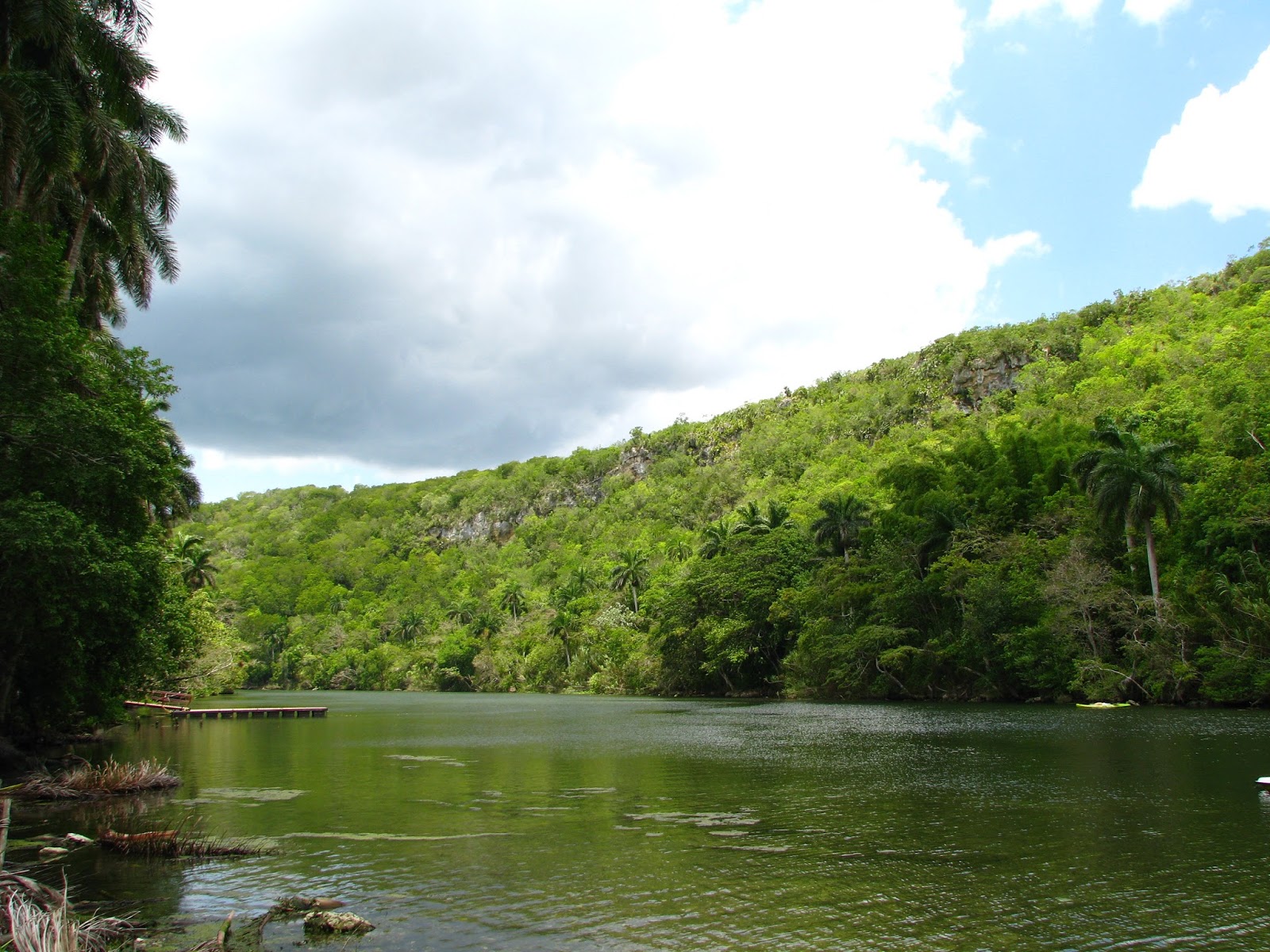
With this in mind, our trip began in the city of Matanzas, on the banks of the Canimar river (fig. 1).


Fig. 2: Cliff cave on the Canimar river gorge, formed on Pliocene limestones of the Canimar fm.

This is a region with deep canyon walls dotted with caves (fig. 2). The caves open up in the limestone of the Canimar formation, rocks that formed between 5 and 2 million years ago in the marine environments that surrounded this region. Then, all this was underwater. Recent tectonic oscillations have risen those lithified marine sediments which the river has carved into a gorgeous, biologically rich gorge; an environment that the Amerindians (native aboriginals) knew how to exploit well.


Fig. 3: The red-legged thrush Tordus plumbeus in the woodlands of the Canimar river. A common member of the local fauna.

The fossil remains of the terrestrial fauna found in the region's cave deposits are very similar to the modern fauna. This fauna is comprised of large rodents called Jutias or Hutias (Capromys spp.), reptiles, amphibians, and a diverse avifauna that includes the red-legged thrush (Tordus plumbeus), like that of figure 3, and the endemic Cuban trogon (Priotelus temnurus) of figure 4.


Fig. 4: The Cuban trogon Priotelus temnurus is a Cuban endemic, and the national bird.

We were targeting caves with large openings or sinkholes (also called dolines) which allow in light, rain, soil, and animals that come to roost within. Other animals wander inside or become trapped, leaving behind the remains of their adventure scattered on the cave floor. As my previous post on Cuban and Hispaniola exploration show (here), these caves are especially important to my research because they have served as a natural reservoir for faunal remains, representative of those that inhabited the region during the last hundred thousand years.


Fig. 5. Large sinkhole complex of Nesofontes' Cave, on Palenque Hill. Here animal
remains accumulated along with other debris that comes in from the outside.

There are few mechanisms that explain the presence of fossil remains within caves. Some fossils are part of the structural rock that makes up the caves. Those fossils are often visible on the cave walls and ceilings. They were part of the marine fauna of the shallow marine environments which gave origin to the limestone that now make up the hills and thus the caves (this process is called karstification if that rock is made out of carbonates like Calcium carbonate). Other fossils are mixed with the soil, plant material, and rock debris that has been dragged into the cave by rain waters or floods over time (fig. 5). Other animals become trapped inside the cave, because they fall in, or are brought in by predators. These are both active and passive mechanisms, both giving way to the accumulation of animal remains within these cavities, and so the treasures of our expeditions.


Fig. 6: Peculiar speleothems within the same cave. This structure testifies to the slow action of carbonatation. 

Caves have interesting water-locked histories. Water that filters through the rocks, laden and heavy with dissolved minerals in their solution, expand cracks within the rocks that eventually, in thousands of years, become caves (like those of fig. 5 and 7). Once these cavities are large enough they start to develop internal microclimates that give way to other secondary formations such as stalactites and stalagmites, collectively called speleothems (fig. 6-8).


Fig. 7: Large lake and sinkhole cave in northeastern Matanzas city: Saturn's Cave. 


Sometimes, parts of the cave's roof or side walls become weak or dissolved by water and collapse, giving origin to the sinkholes mentioned above. These apertures are the key to large deposit formations inside the cavities, and also to the arrival and adaptation of fauna to the different light microenvironments within them. Light does not penetrate into the cave evenly. Instead, light penetrates the cave following square laws that dictate that light is strongest near the opening or source, and weaker or nonexistent deeper into the depths of the cave. This leaves areas of penumbras and umbras in between. Living organisms have evolved to inhabit all these microbiomes.


Fig. 8: Megastalactite speleothems called Columbus Drape at the famous Bellamar Cave
 in Matanzas city. This structure is massive and has taken thousands of years to form. Use hand railing on
the upper left for scale. 

Other caves become inundated creating lakes, pools, and gours. These underwater dark environments are the origination grounds from which specific cave faunas evolve. These organisms range from bacteria to fishes, crabs and shellfish, that in the darkness of the caves have lost their eyes and pigmentation. In this sense, caves can be like islands: laboratories for natural selection and evolution.

The same water that percolates through cracks and crevices can create really marvelous, intricate structures after many thousands of years of drip and drips of water, such as those of figures 6, 9-10.


Fig. 9: Flow-stone grew from dripstone speleothems on Bellamar Cave, Matanzas.

In the same sense that caves are natural laboratories for the evolution of weird organisms, caves are natural laboratories for mineral formations. Out of drips of water, minerals precipitate out forming the aforementioned speleothems. Many of them often forming delicate and aberrant or exuberantly- shaped structures (like the anomolites or anomoliths of figure 10, at Bellamar Cave). These include drip stones, flow-stones (fig. 9), and even structures called "pine trees" or "cave pearls".  In the case of the delicate anemoliths, crystallization of the bicarbonates occurs as the filtered water, higher in CO2 concentrates, encounters the lower CO2 pressure inside the cavity, precipitating these crystals in the direction of the wind (fig. 10). These secondary structures can become natural perches to the volant fauna that inhabit the cave walls.


Fig. 10: Anemoliths of the Bellamar Cave. Peculiar and beautiful secondary formations,
indicative of specific cave microclimates.

Bats are the most famous of cave inhabitants. Many bats are strict cave dwellers, using caves to roost during the day and reproduce. Like the Cuban fruit bat Artibeus jamaicensis of figure 11, bats often select specific rooms inside the cave based on their proximity to the entrances, their internal temperatures, where they can segregate or mix with other species to roost. Other bats are peculiar in being solitary, meeting with their opposite sex only for reproduction during specific seasons, or selecting cave rooms with very high temperatures and humidity. Caves in which temperatures rise higher than 40 degrees Celsius and humidity is greater than 80 percent are called "hot caves", and some bats live exclusively in those. Our research often involves studying such specifically evolved bat fauna.


Fig. 11. Large Cuban fruit bat Artibeus jamaicensis parvipes.

My research also involves studying other faunas, of a more resent epoch. For example, my interests also involve zooarcheology, which is the study of fauna remains associated to human occupied or originated deposits. Such deposits span through aboriginal and colonial deposits, which can help understand the complexity of human-influenced faunal extirpation or domestication.


Fig. 12: El Morrillo, an 18th-century coastal fort on the bay of Matanzas, Cuba. 

Colonial occupation in the Caribbean, as in other parts of the New World after European rediscovery, gave way to modification of natural environments, the introduction of exotic-invasive faunas, of which remains can be found in or around colonial structures, such as that on figure 12 and 13.


Fig. 13: Frontal view of the Morrillo fort on the bay of Matanzas.

This fort served, as did fort San Severino of my previous post, in the coastal protection against illicit trade and pirate attacks throughout the colonial period. Generations of human habitation in these structures have left behind a good record of the use of the local and imported fauna. These deposits are often extensive, including faunas from before and after human occupations, which in turn are great for our study of the influence of mankind on natural faunas, and for establishing relative chronologies to these events.


Fig. 14: Sunrise in the Bay of Matanzas, northwestern Cuba.

From Matanzas, we traveled to another important, but much older karstic region: Pinar del Rio, in western Cuba (fig. 15). Pinar del Rio has a long standing history in the study of Cuban paleontology and geology, attracting the attention of prominent Cuban naturalists like Carlos de la Torre, Felipe Poey, and others since the late 18th century. Explorers have found fossils inside its caves and on its rocks. This region has some of Cuba's oldest rocks, and within its rocks is written the life history of the Caribbean region (fig. 15-17).


Fig. 15: Vinales Valley in Pinar del Rio, western Cuba.

In our search for old faunas, we extended our explorations to Vinales, a unique valley within the aforesaid region (fig. 15-16). This region is unique for many reasons. One is its extensive karst development, including uncountable honeycombs of mammoth caves within its limestone (fig. 17). These same limestones date back to the middle Jurassic when the Caribbean basis did not exist. However, these conic "mogote" formations we see are geologically recent, dating approximately to the Pliocene, between 5 to 2 million years ago.

The Guaniguanico mountain range is a unique karts region of the world. It includes 400-500 meter tall conic karts formations that resemble giant elephants such as those of the Sierra de Los Organos (the "Sierra of the Organs"). There are other parts of the world with such conic or cockpit karst.  Formations such as those of figures 15 and 16 are present in Jamaica, Hispaniola, Puerto Rico, and Guangxi in China. With the two extremes being the Vinales and the Chinese Guangxi.


Fig. 16: Giant elephant-like hills over 400 m in height called Mogotes, are formed out of uplifted Jurassic limestones.

Salvador Massip and Sara Isalgue wrote in 1923 "Cuba came from the depths of the ocean..."Vinales limestones contain fossil remains of prehistoric marine reptiles and mollusks, such as Plesiosaurus, ammonites, and belemnites. I went there searching for fossils of the early Cretaceous - a period several dozen million years younger than the Jurassic. I am interested in records which provide signals of oceanic anoxic events (OAE) and their effect, in this case of extinction-origination- of microfaunas such as phytoplankton and zooplankton. Forams, short for foraminifera, are microscopic single celled-organisms (heterotrophic Protists) that are part of the zooplankton. Forams can live in ocean bottom sediments (called benthic) or float along the surface of deep oceans (planktonic). When they die, they accumulate slowly on the ocean bottom, becoming part and originating sediments. Their shells or test then provide a record of the surrounding fauna and an approximation for the climate.


Fig. 17: Hanging caves at different levels within the Mogotes, indicating the effects of water at different uplift levels.

By chemically studying these fossil organisms we can determine if there were reducing or oxidizing conditions in the ancient oceans that may have lead to massive die-offs, such as is the case of the OAEs, which could further an understanding of the environment during the early stages of the embryonic Caribbean basin.

But I apologize. I have allowed my enthusiasm to extend this post larger than expected. I hope it has been interesting. But by no means, does it encompass the natural beauty or scientific attraction that the Caribbean, especially Cuba,  possess for these kinds of research. In the end, the goal is the same across geological time: to elucidate and deepen our knowledge of the awesome history of our "Pale Blue" planet.

Stay tuned for more post!


Friday, July 17, 2015

Cave Fieldwork in Cuba: 2002 - 2004


The early years of the new millennium were very productive for my research in Cuba. Our explorations, between 1995 and 2002, turned up very interesting fossils, representing rare and extinct faunas. The fruits of these explorations included two new records for Cuba, pertaining to two of the Caribbean's rarest fossil bats: the common vampire bat Desmodus rotundus and Peter's ghost-faced bat Mormoops megalophylla (articles can be downloaded here).

Fig. 1: An articulated skeleton of Mormoops blainvillei at Cueva de la Pluma (Cave of the Feather) in northern Matanzas, Cuba. This species is almost identical but smaller, than Mormoops megalophylla of the continent.

Our fieldwork began in the foothills of the Alturas Habana-Matanzas, a chain of lowland limestone hills that run W to E on the northern coast of Cuba. Uplift and exposure of these limestones during the last 5 million years has given origin to a vast cave region laden with fossil deposits, dating to the last glacial and inter-glacial period.

Fig. 2: Palenque Hill, a lowland limestone hill of the Havana-Matanzas range.
This is a karstic relict of uplifted Miocene seafloor that surrounded this region.

Within this region, we focused on a 200-meter high hill named Palenque (fig. 2-3). The hills of Palenque served as a shelter to runaway aborigines and slaves throughout the colonial period. A "palenque" is the name given to such a hideout. We selected this region mainly because of unstudied caves discovered in the 1980s, with an interesting biotic richness and endemism, characteristics that had attracted two of Cuba's foremost naturalists Carlos de la Torre and Johannes Gundlach a century before. They visited Palenque's hillside in search of unique mollusks, mammals, and birds.

Fig. 3: Karstic vegetation on the escarpment of Palenque hill, at about 180 meters above modern sea level.

A secondary but well preserved tropical semideciduous forest covers Palenque (fig. 3) with a flora that includes several kinds of trees including oaks and mahogany (Quercus and Swietenia spp.), gumbo limbo (Bursera simaruba), Royal Palms (Roystonea regia), plus other Thrinax-like palms in the upper levels. There is even coffee (Coffea arabica) brought into some caves by large fruit bats (Artibeus and Brachyphylla) and birds. Most of the lower level vegetation that extends to the agricultural savanna at the foothills include several kinds of grass, the poison ivy, locally known as Guao (Comocladia dodonea) and the toxic Chichicate (Urtica dioica).


Fig. 4. Main sinkhole of Nesfonte's cave, one of the largest cave of the Palenque, and probably the most extensive.
This is the main owl repository where most of the owl pellets have been accumulating for more than 2000 years. 

Fig. 5: The Cuban tarantula Phormictopus cubensis,  part of the penumbra cave fauna.

These fossil deposits originated from animal and plant remains mixed in with soil dragged into the caves by rainwater. Other were brought in by raptors, for example in vomitus, a form of hairball called pellet. Raptors, owls, and hawks do not fully digest bone and hair. Instead, they regurgitate them in the form of such pellets which accumulate in their cave roosts by the thousands (fig. 1, 6-7; note the round and brown pellet on the right of fig. 6). Because these raptors reuse the same roost areas from generation to generation their nests can include several thousand years of prey/pellet records. Even though their diet is selective, meaning they pick and choose from what prey is available in nature, theses pellets can provide a good record of the local fauna. The caves of Palenque provide an excellent record of that.

Fig. 6: A common vampire bat Desmodus rotundus skull in situ at the moment of discovery.
See the skulls of the brown bat Eptesicus fuscus (on far left) and large Cuban fruit bat Artibeus jamaicensis
skull (on upper right). A fresh owl pellet is next to the vampire bat skull,
 and some fresh material remains inside its braincase, testifying to its freshness.

The first serious discovery came from a newly discovered room in Cueva de la Caja or the Cave of the Box (fig. 3-4), also known as Cueva de Los Nesofontes or Nesofonte's cave, named so for the huge accumulation of Nesophontes fossil remains (more on this curious species on a future post). As archaeologist R. Viera and I explored a section of the cave, we accidentally stumbled upon a small mound on the floor of a newly discovered side room that had gone unnoticed on previous expeditions in 1994 and 2002 (Viera and Orihuela, 2006). In it, there were plant seeds scattered in a mound on the cave's floor and a vampire bat skull right on top like a cherry on the cream (fig. 6-8).


Figure 7: The vampire bat deposit as it looked before excavation on 22 December 2003.

What an interesting and unexpected discovery! At that time, vampire bats had been discovered only three times before, all exclusively from Cuba (Mayo and Woloszyn, 1974; Silva, 1979). As of today, vampire bats have not been discovered anywhere else in the greater Caribbean.

Desmodus rotundus is endemic to the New World neotropics, where it is well distributed from Mexico all the way down to northern Argentina, but in the past, that distribution included Florida, Cuba. The first fossil record came from Cueva Lamas in Havana. This fossil was discovered by Cuba's foremost paleontologist at the time Oscar Arredondo, who then sent the specimen to Dr. Karl Koopman, chiropterologist (=bat-ologist) who identified it as a common vampire bat Desmodus rotundus, identical to the continental species. In the following years, other researchers found two more specimens from which a new endemic subspecies, Desmodus rotundus puntajudensis, was erected (Woloszyn and Mayo, 1974; Jimenez et al., 2005). Later, the Cuban paleontologist William Suarez (Suarez, 2005) raised the species to the rank of full species, which made it a full Cuban endemic.

Fig. 8: Common vampire bat (Desmodus rotundus) after it's discovery at Nesophonte's cave.

However, the study of our well-preserved specimen (fig. 8-9) showed it was not referable to the new endemic form. Instead, our analysis of the skull characteristics of the continental form D. rotundus versus that of the endemic D. puntajudensis revealed that the Cuban fossils fell within D. rotundus, and did not represent a new form (Orihuela, 2011). This agreed with Koopman's original identification of the first specimen. As it seems, the Cuban fossil vamps are the same as the continental species, which may have arrived at the island during the last 10,000 years or less.


Fig. 9. Three of the four known Desmodus rotundus skulls from the Cuban Quaternary fossil record.
 Our specimen is on the far right. Line illustration from Orihuela, 2011 (copyrighted). 

An endemic form would suggest long isolation for such evolution to occur. And the presence of both, an endemic species (or subspecies) and the continental form, seems unlikely out of so poor of a record. So far, the fossil Desmodus specimens are associated with ages less than 8000 years before the present, and thus within our own current inter-glacial period, but none date to the late glacial period as was originally considered. In fact, we do not know if they were true relics of the past glacial fauna.

Osvaldo Jimenez Vazquez and his colleagues discovered vampire specimens from a cave deposit in southern Mayabeque province (formerly Havana province), providing the first radiocarbon date associated with vampire bat fossils in Cuba. Their remains dated, although indirectly, about 7000 years before the present (Jimenez et al., 2005). Our specimen posed a more complex problem and brought about new questions. They were dated, indirectly as well, between the 1950s to the 1990s (Viera and Orihuela, 2006; Orihuela, 2012; Orihuela et al. in prep.). Unfortunately, neither Cuban vampire fossil has been dated directly due to the rarity of the fossils.

Fig. 10: Pteronotus parnelli parnelli (Mormoopidae) from a transient local population at Nesophonte's cave.

What is sure is that there were vampire bats in Cuba until very recently, even if just accidentally. Our research using maximum entropy software such as Maxent, DIVA and R, employed to predict and model which bioclimate variables could have limited bat distribution, and if any of the variables could have lead to their extinction, suggests that the climate of the last 7000 years, up to our modern climate, is still appropriate to sustain many currently extinct Cuban bats including the vampire bats (work in prep.). Their extinction is considered concomitant to the extinction of the large sloths (like those I mentioned in my previous post here), which were likely part of their diet. Now we know that these sloths did not disappear during the late glacial epoch either, but instead during the last 5000 years, which is within our current inter-glacial.

So what does this mean? Where vampire bats accidentally present in the Cuban fossil record? If so, why are their fossils so rare considering how easily adaptable and reproducible the species is on the mainland? Are Desmodus fossils present in other Antillean fossil records? These are questions our current research is hoping to resolve. Stay tuned!


I want to take this opportunity to thank those that have helped on this research. First, I am eternally thankful to all those that participated in this expedition and those colleagues that helped with the analysis, their encouragement and help. These are archeologist Ricardo Viera, geographer Leonel Perez-Orozco, biologist Adrian Tejedor, Candido Santana and Joel Monzon, and many other more friends and colleagues that have made this research possible. These expeditions would have been impossible without their enthusiastic support.


This post is dedicated to the memory of Johannes Gundlach, whose birthday we celebrate today.


References

Atlas Nacional de Cuba 1969-1985.

Arredondo, O. 1958. El Vampiro Cubano. Scout 10:6-7.

Jiménez, O., M. M. Condis, and E. García. 2005. Vertebrados post-glaciales en un residuario fósil de Tyto alba scopoli (Aves: Tytonidae) en el occidente de Cuba. Revista Mexicana de Mastozoología, 9:84-111.

Koopman, K.F. 1958. A fossil vampire bat from Cuba. Breviora 90:1-4.

Silva-Taboada, G. 1979. Los Murciélagos de Cuba. Editorial Academia, La Habana. 424pp.

Orihuela, J. 2011. Skull variation of the vampire bat Desmodus rotundus (Chiroptera: Phyllostomidae): Taxonomic implications for the Cuban fossil vampire bat Desmodus puntajudensis. Chiroptera Neotropical 17(1): 963-976.

Orihuela, J. 2012. Late Holocene fauna from a cave deposit in Western Cuba: post-Columbian occurrence of the vampire bat Desmodus rotundus (Phyllostomidae: Desmodontinae). Caribbean Journal of Science, 46 (2): 297-313.

Orihuela, J., and A. Tejedor. 2012. Peter's ghost-faced bat Mormoops megalophylla (Chiroptera: Mormoopidae) from a pre-Columbian archaeological deposit in Cuba. Acta Chiropterologica 14(1): 63-72.

Orihuela, J., R. Viera, and L. Vinola. 2017. New bat records based on modern and fossil remains from the province of Matanzas, Cuba.

Suárez, W. 2005. Taxonomic Status of the Cuban Vampire Bat (Chiroptera: Phyllostomidae: Desmodontinae: Desmodus). Caribbean Journal of Science 41 (4):761-767.

Woloszyn, B.W., and N.A. Mayo. 1974. Postglacial remains of a vampire bat (Chiroptera: Desmodus) from Cuba. Acta Zool.Cracoviensia 19:253-265.


Saturday, July 4, 2015

La Pictografía de la Cueva del Ciclón: ¿Primate o Chamán?


Por Osvaldo Jiménez Vázquez

Especialista mastozoólogo del Gabinete de Arqueología, Oficina del Historiador de la Habana, Cuba 


Las cuevas de Cuba guardan en sus recintos importantes testimonios gráficos de nuestros primitivos habitantes. Estos testimonios, conocidos como arte rupestre, están plasmados sobre paredes, techos y formaciones secundarias de más de un centenar de cuevas.

El arte rupestre cubano lo conforman dos tipos de manifestaciones, las pictografías y los petroglifos, ambos relacionados con creencias religiosas. Una de las pictografías más enigmáticas de Cuba, hoy infelizmente desaparecida, se encontraba en la Cueva del Ciclón, espacio hipógeo conectado con la Cueva del Gato Jíbaro, enmarcada en el Sistema Cavernario de Bellamar, costa norte de la provincia de Matanzas.

El hallazgo de este pictograma fue realizado por integrantes del grupo espeleológico Norbert Casteret entre abril y mayo de 1981, como parte de los estudios arqueológicos que realizaban en la región (imagen 1). La pictografía había sido realizada sobre un manto estalagmítico, formación secundaria situada a unos 25 metros de la entrada de la cueva y a unos 10 metros de una dolina de disolución y desplome que se halla en el centro geográfico del antro. El carbón vegetal fue el material empleado en la ejecución de la misma, por lo cual su color era negro. Su altura no superaba los 10 cm. Tanto la pictografía, como un conjunto de murales pictográficos localizados a 12 metros de esta, representan conceptualmente el estilo de “líneas inconexas” (Maciques, 1988), el cual fue ejecutado por aborígenes preagroalfareros (siboneyes). La cultura material rescatada en esta localidad confirma la relación cultural, apareciendo en las excavaciones practicadas, restos de dieta y sílex tallado (Leonel Pérez Orozco, com. pers).

Imagen 1: Foto original de la pictografia de la cueva del Ciclon, ciudad de Matanzas, Cuba.

A raíz del hallazgo, los investigadores del grupo espeleológico Norbert Casteret publicaron unas notas en el boletín que producía este colectivo (no.3 año III, 1982, Matanzas), incluyendo una reconstrucción ideal de la pictografía (imagen 2), manifestando que la misma representaba la figura de un mono araña (Ateles). Posteriormente, el paleontólogo cubano Oscar Arredondo (1983), apoyó este criterio, el cual a través del tiempo ha sido sostenido por otros autores (Gutiérrez y Jaiméz, 2007).

En busca de la verdad sobre este asunto, acudimos a Leonel Pérez Orozco, actual director de la Oficina del Conservador de la Ciudad de Matanzas, quien fuera presidente del grupo espeleológico Norbert Casteret en los momentos del hallazgo de la pictografía. Este buen amigo, quien ya no cree que la pictografía representara un primate, nos facilitó la única imagen fotográfica que existe de la misma (imagen 1). La reconstrucción ideal y la fotografía no pueden ser comparadas correctamente, pues la primera representa una vista frontal, y la segunda, por problemas de espacio dentro de la cueva, fue tomada desde un plano inferior. No obstante, se observan diferencias. Por ejemplo, en la fotografía la cabeza tiene forma ovalada y no está encajada entre los hombros, por otra parte, los brazos están más abiertos y ambos son iguales, a diferencia de lo que se observa en la reconstrucción. Las piernas, por su parte, están dibujadas en la reconstrucción con un trazo único, en tanto, en la foto apreciamos trazos discontinuos, como corresponde al estilo de líneas inconexas. Esta pictografía sugiere, más bien, una figura antropomorfa danzando o adorando, quizás represente un chamán en medio de un evento religioso.

Imagen 2: Interpretacion de la pictografia del Ciclon. Notece que esta reproduccion no es fiel a la original.

Existen hechos de otra índole que refutan la representación de un mono en este pictograma. En primer lugar, los aborígenes preagroalfareros y agroalfareros (taínos) cubanos habían sustituido desde siglos atrás los referentes faunísticos continentales de su cultura, de tal manera que en el arte precolombino, sobre todo agroalfarero, son motivos reiterados lechuzas, búhos y murciélagos. Algunos autores (Harrington, 1921; Arredondo y Varona, 1983) opinaron que ciertos diseños modelados en las asas de recipientes de la cultura antes citada correspondían a rostros de monos. Sin embargo, en la actualidad se considera que tales diseños representan rostros de murciélagos (Rodríguez, 2000; Rodríguez, 2002; Borroto y Arredondo, 2011), animales que, al igual que aves nocturnas como búhos y lechuzas, estaban posiblemente relacionados con el Coaybay, lugar a donde van las opías o almas de los muertos, señorío de Maquetaurie Guayaba (Pané, 1984). Por último, las investigaciones paleontológicas demuestran que el mono de Varona (Paralouatta varonai) única especie de primate del Cuaternario endémica de Cuba, se extinguió mucho antes del arribo del hombre precolombino a Cuba (Silva et al., 2007), y el mono de Montané (Ateles fusciceps), descubierto en la Cueva de la Boca del Purial en 1888, fue introducido hace menos de 300 años desde Sudamérica (Miller, 1916b; MacPhee y Rivero, 1996).

Referencias 


Arredondo, O., y L. S. Varona. 1983. Sobre la validez de Montaneia anthropomorpha Ameghino, 1910 (Primates: Cebidae). Poeyana, 255: 1-21.

Borroto Páez, R. y C. Arredondo Antúnez. 2011. Los mamíferos en el arte aborigen. 213-219. En: Mamíferos en Cuba. (Eds. R. Borroto-Páez y C. A. Mancina). UPC Print, Vaasa, Finlandia. 271 pp.

Gutierrez Calvache, D. y E. J. Jaiméz Salgado. 2007. Introducción a los primates fósiles de Las Antillas. 120 años de primatología en el Caribe insular. Santo Domingo, Editora Universitaria, 208 pp.

MacPhee, R. D. E., y M. Rivero de la Calle. 1996. Accelerator mass spectrometry 14C age determination for the alleged "Cuban spider monkey", Ateles (= Montaneia) anthropomorpha. J. Human Evol., 30:89-94.
Maciques Sánchez, E. 1988. El arte rupestre de Matanzas. Revista Museo, Año I, 2° Época, junio de 1988, Matanzas, Cuba.
Miller, G. S., Jr. 1916. The teeth of a monkey found in Cuba. Smithsonian Misc. ColI., 66(13):1-3, 1 lam.
Orihuela, J. and A. Tejedor. 2012. Peter's ghost faced bat Mormoops megalophylla (Chiroptera: Mormoopidae) from a pre-Columbian archaeological deposit in Cuba. Acta Chiropterologica, 14(1): 63-72. Available here.
Pané, R. 1984. Relación acerca de las antigüedades de los indios. México, Siglo XXI Editores S. A.
Rodríguez Arce, C. 2000. Apuntes sobre la figura del murciélago en la iconografía prehispánica de Cuba. El Caribe Arqueológico, 4: 94-99.
Rodríguez Durán, A. 2002. Los murciélagos en las culturas precolombinas de Puerto Rico. Focus, 1 (2): 15-18.
Silva Taboada, G., W. Suárez Duque y S. Díaz Franco. 2007. Compendio de los mamíferos terrestres autóctonos de Cuba vivientes y extinguidos. La Habana, Editorial Boloña, 465 pp.


Shaman or Monkey?


Hello everyone out in the interverse. I have just recently returned from a very successful fieldwork season in Cuba, of which I will be posting about soon, but for the time being I have an interesting piece written by my colleague and friend Osvaldo Jimenez to share.  If you haven't yet seen them, he's the author of several previous posts on fossil monkeys and the discoverer of some of those interesting fossil remains.

His new post titled "Shaman or Monkey" (in Spanish: ¿Primate o Chamán? ) deals with the discovery and interpretation of a very enigmatic cave pictograph representing what seems to be a dancing human figure, originally interpreted as an erect monkey (fig. 1).

Figure 1: Cave pictograph of Ciclon Cave (or Cave of the Cyclone) discovered by members of the local speleological group Norbert Casteret in Matanzas city, Matanzas, Cuba.

Osvaldo's post tells the story of a local speleological group, so named Norbert Casteret in honor of that famous speleologist, that in 1981 discovered the interesting pictograph on a cave named Cyclone. This pictograph is enigmatic because it has disappeared from the cave wall, and so out of the radar of those interested in its study.

A cave pictograph is a form of Amerindian cave art executed with charcoal or any other form ocher-black colorants or pigments applied directly on a cave wall. These are somewhat common in the Greater Antilles, and especially Cuba, where they reach a high degree of technical detail and complexity. Such is the case of the concentric circles of Punta del Este, on the Isle of Pines (fig. 2), or Ambrosio Cave in the Varadero peninsula (fig. 3), northwestern Cuba.

Figure 2: Main concentric circle pictograph in Puna del Este, Isle of Pines. Photo and courtesy of Cuban archaeologist Jorge Garcell Dominguez.

Figure 3: Cave pictograph number 28 from Ambrosio Cave in Varadero, northwestern Cuba.

Such cave art is attributed to Cuban Amerindians, originally named Siboney, but that for the sake of simplicity is now grouped with similarly related cultures such as the Guanahatabey. These Amerindians lived in Cuba between 5000 and 1800 years before the present (Dacal and Rivero de la Calle, 1996), had no ceramics, and only a simple shell-based toolkit. They inhabited coastal areas and used caves for religious-ritualistic purposes, including artistic expression and burial.

Much research has been conducted of these cultures and their artistic expressions and will be too extensive to cite here. For the interested reader the work of the late Dr. Antonio Nunez Jimenez titled Cuba: "Dibujos Rupestres" (1975), "Cuevas y Pictografias", and "El Arte Rupestre Cubano" (1986), in addition to "Art and Archaeology of Pre-Columbian Cuba" (1996) by Ramon Dacal Maure and Manuel Rivero de la Calle could serve as great introductory material.

Since the late 1980s, there has been a revival in the study and interpretation of this culture's art form in Cuba. At the forefront of such investigation are the archaeologist Esteban Maciques Sanchez, Roger Arrazcaeta, director of the Archaeological Cabinet (an archaeologically oriented sub-office of the Historian's Office in Havana, Cuba), and Jorge Garcell Dominguez to name a few. Some of the current work has concentrated on dating, interpreting, and correlating these Amerindian artistic manifestations with burial rituals, and the possible influence of the moonlight-sunlight cycles within the cave's space. Such news can be accessed on the site Cuba Arqueologica. For the relevant citations, the reader is directed to Osvaldo's interesting post.


Figure 4: Palenque Hill pictograph discovered by Leonel P. Orozco and myself on 1 of June this year.

Incidentally and to my great surprise, I made my first cave art discovery during a recent excursion to the caves of the Serrania del Palenque, a lowland limestone hill formation in the northwestern province of Matanzas. These seemed to be the intricate remains of a probable more complex piece that have now been erased by time (fig. 4).  However, the origin and age of this pictograph is presently unknown and currently researched. But it seems to be one of the very few discovered in the region!

I hope you all enjoy these ventures and stay tuned for more puzzle pieces from the Greater Antillean paleoworld.